
Book in short
Frankenstein summary
This Frankenstein summary covers Mary Shelley’s famous novel in plain words. A young scientist gives life to a creature, then runs from what he has made. The book asks a simple, hard question: what do we owe to the things, and the people, we bring into the world?
- Author
- Mary Shelley
- First published
- First published anonymously in London on 1 January 1818. Mary Shelley published a revised edition under her own name in 1831.
- Length
- 4 letters and 24 chapters
- Type
- Gothic novel, early science fiction
- Read the book free
- Project Gutenberg eBook #84 (public domain in the US)
- This summary
- Story in about 2 minutes
The story in short
The novel opens with letters from Robert Walton, an English explorer sailing toward the North Pole. His ship is trapped in ice when the crew sees a huge figure crossing the ice on a dog sledge. The next day they rescue a weak, half-frozen man: Victor Frankenstein. Victor tells Walton his story as a warning.
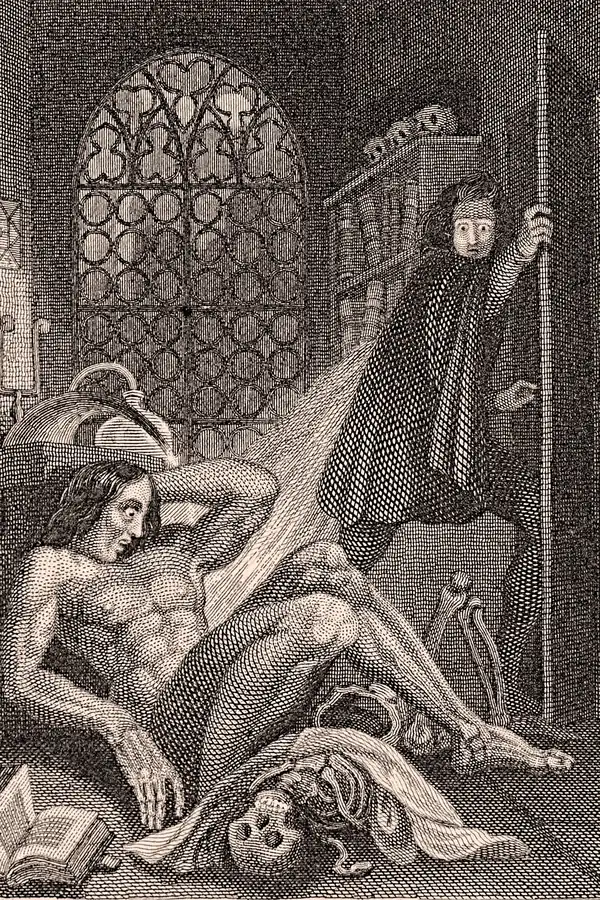
Victor grows up in a loving family in Geneva. As a student at the university of Ingolstadt he becomes obsessed with the secret of life. Working alone for many months, he builds a creature about eight feet tall and brings it to life. The moment it opens its eyes, Victor is horrified by its appearance. He runs away and leaves the creature alone.
The creature wanders, confused and rejected by everyone who sees it. It hides beside a cottage and secretly watches a poor family, the De Laceys. By listening, it learns to speak and read. It finds three books, Paradise Lost, Plutarch’s Lives and The Sorrows of Werter, and starts to think about who it is. When it finally shows itself to the family, they are terrified and drive it away.
Full of pain and anger, the creature turns against its maker. Victor’s little brother William dies, and Justine, a kind young woman who works for the family, is wrongly blamed and put to death. Victor knows the creature is responsible but says nothing.
High on a glacier near Mont Blanc, the creature finds Victor and tells its side of the story. It asks for one thing: a female companion like itself. If Victor agrees, the two will leave for the wild lands of South America and never trouble people again.
Victor agrees and starts the work on a lonely island in the Orkneys. But he is afraid of what two creatures might do, so he tears the half-finished companion apart while the creature watches. The creature swears revenge: “I shall be with you on your wedding-night.”
Victor’s closest friend, Henry Clerval, dies. On Victor’s wedding night, his bride Elizabeth dies too, and soon after his father dies of grief. Victor gives his life to hunting the creature, following it north across the ice until Walton finds him.
Victor dies on Walton’s ship. The creature comes to his body and mourns him. It tells Walton it will go to the far north and never be seen again, and drifts away on a raft of ice into the darkness.
Spoiler note: this summary tells the whole story, including the ending.
Main characters
- Victor Frankenstein: A brilliant, proud young scientist who creates life and then refuses to care for it.
- The creature: Victor’s creation, never given a name. Gentle and eager to learn at first, it becomes bitter after constant rejection.
- Robert Walton: The explorer who rescues Victor and writes the story down in letters to his sister.
- Elizabeth Lavenza: Raised in Victor’s family and later his bride.
- Henry Clerval: Victor’s cheerful, loyal best friend.
- The De Lacey family: The poor cottagers the creature watches and learns from.
- Justine Moritz: A gentle young woman in the Frankenstein household, wrongly blamed for William’s death.
Themes
- Ambition: Victor’s hunger for discovery blinds him to what his work will cost.
- Family: The creature has no parent to guide it, while Victor’s own family pays for his choices.
- Friendship: Clerval’s loyalty shows what the creature longs for and never gets.
- Loneliness and rejection: the creature’s goodness is worn away by being shut out.
Key lessons from Frankenstein
- Think about results before you startVictor never asks what he will do once the creature lives. Big projects need a plan for afterwards.
- Take responsibility for what you makeRunning away from a problem does not end it. Victor’s silence makes everything worse.
- How we treat others shapes themThe creature says plainly that misery made it cruel. Kindness or rejection changes people.
- Knowledge needs wisdomVictor warns Walton how dangerous it can be to chase knowledge without limits.
- Loneliness hurts deeplyThe creature asks for only one thing: someone to be with. Everyone needs connection.
Who should read it?
- Readers who like ideas as much as plot: the book raises questions about science and responsibility that still matter.
- Fans of gothic stories, storms and dark settings.
- Anyone who only knows the film monster and wants to meet the thoughtful creature of the original book.
Quotes from Frankenstein
Copied word for word from the public-domain text on Project Gutenberg, with the chapter each line comes from.
how dangerous is the acquirement of knowledge
Frankenstein, Chapter 4I was benevolent and good; misery made me a fiend.
Frankenstein, Chapter 10I ought to be thy Adam, but I am rather the fallen angel
Frankenstein, Chapter 10Life, although it may only be an accumulation of anguish, is dear to me, and I will defend it.
Frankenstein, Chapter 10Beware, for I am fearless and therefore powerful.
Frankenstein, Chapter 20
If you liked it, read these next
- Moby-DickAnother man who destroys himself chasing one huge goal.
- Wuthering HeightsA gothic tale of an outsider shaped by rejection.
- Jane EyreGothic mystery, a lonely childhood and a fight to be treated fairly.
- A Christmas CarolA shorter story about a man forced to face what his choices have done.
Frequently asked questions
Is Frankenstein the name of the monster?
No. Frankenstein is the scientist, Victor Frankenstein. The creature he makes is never given a name in the book.
How old was Mary Shelley when she wrote Frankenstein?
She began the story at 18, during a wet summer near Lake Geneva in 1816, and the book came out on 1 January 1818, when she was 20.
What is the main message of Frankenstein?
Creators are responsible for what they make, and rejection can turn a good being bitter. It also warns about chasing knowledge without thinking of the results.
Which version of Frankenstein should I read?
Both are fine. The 1818 first edition is closer to Shelley’s first idea; the 1831 edition has her famous introduction and some changes. Project Gutenberg has the full text free.
Explore more
- Mary Shelley1797 to 1851
- Classic books about ambitionTheme
- Classic books about familyTheme
- Classic books about friendshipTheme
- Famous book quotesExact quotes from classic novels
- Life lessons from famous booksWhat the classics teach
- Classic books to readA starter list
Sources
- Project Gutenberg eBook #84: full text of Frankenstein (plot and every quote checked against it)
- Wikipedia: Frankenstein (publication facts)
- Wikipedia: Mary Shelley
Checked for this page before publishing. Found a mistake? Tell us.
Published 2026-10-27. Last checked 2026-10-27.