
Book in short
A Christmas Carol summary
This A Christmas Carol summary walks through Charles Dickens’ short ghost story, one stave at a time. A mean old man is visited by ghosts on Christmas Eve, and wakes up changed.
- Author
- Charles Dickens
- First published
- First published in London on 19 December 1843 by Chapman and Hall, with illustrations by John Leech.
- Length
- 5 short chapters, called staves
- Type
- Novella, ghost story
- Read the book free
- Project Gutenberg eBook #46 (public domain in the US)
- This summary
- Story in about 2 minutes
The story in short
Stave One. On a freezing Christmas Eve in London, Ebenezer Scrooge sits in his office counting money. He is rich and very mean. His clerk, Bob Cratchit, works in the cold because Scrooge will not pay for more coal. Scrooge turns down his cheerful nephew Fred’s invitation to Christmas dinner and sends away two gentlemen collecting money for the poor. “Bah!” he says, “Humbug!”
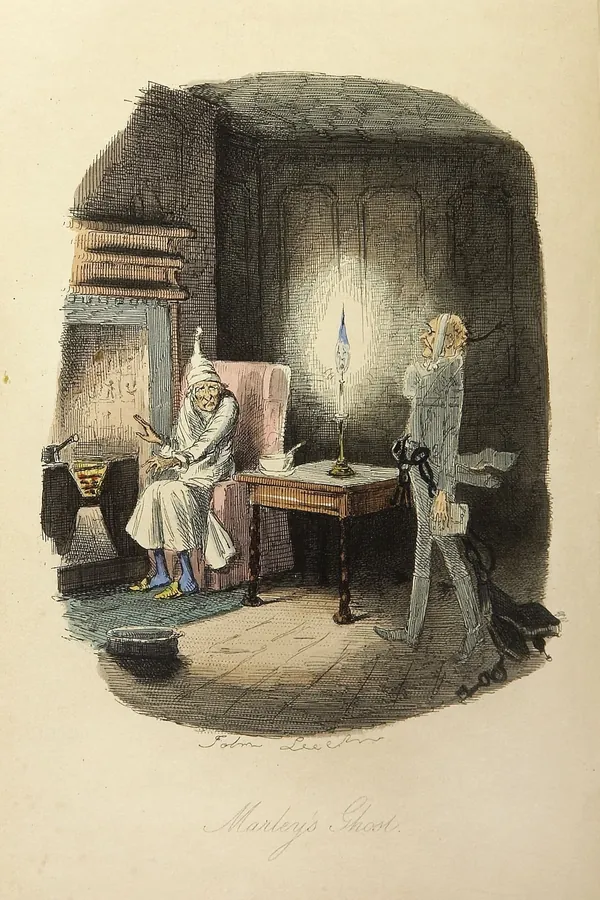
That night, Scrooge is visited by the ghost of Jacob Marley, his business partner, who died seven years before. Marley is wrapped in a heavy chain he made from his own greed in life. He warns Scrooge that three spirits will visit, his last chance to escape the same fate.
Stave Two. The Ghost of Christmas Past shows Scrooge his own childhood: a lonely boy left at school over the holidays, his loving little sister Fan, and his happy days as an apprentice to the generous Mr Fezziwig. It also shows Belle, the young woman who ended their engagement because Scrooge had come to love money more than her.
Stave Three. The Ghost of Christmas Present takes Scrooge through the city on Christmas Day. He sees the Cratchit family enjoying a small but happy dinner, and Tiny Tim, Bob’s youngest son, who is ill and uses a crutch. The spirit warns that Tim may not live unless things change. They visit Fred’s party, where Fred still wishes his uncle well. Before leaving, the spirit shows two wretched children called Ignorance and Want.
Stave Four. The silent Ghost of Christmas Yet to Come shows Scrooge a man who has died. Business men joke about his funeral, and poor people sell off his belongings. The Cratchits mourn Tiny Tim. Finally Scrooge sees a neglected gravestone with his own name on it. He begs for the chance to change.
Stave Five. Scrooge wakes on Christmas morning, full of joy that he still has time. He sends the biggest turkey in the shop to the Cratchits, gives a large gift to the poor, and goes to Fred’s dinner. The next day he raises Bob’s salary. He becomes a second father to Tiny Tim, who does not die, and he keeps Christmas in his heart for the rest of his life.
Spoiler note: this summary tells the whole story, including the ending.
Main characters
- Ebenezer Scrooge: A rich, cold, lonely old man who loves money above everything.
- Jacob Marley: Scrooge’s dead partner, who comes back as a ghost to warn him.
- Bob Cratchit: Scrooge’s poorly paid, cheerful clerk.
- Tiny Tim: Bob’s youngest son, sick but always hopeful.
- Fred: Scrooge’s kind nephew, who never gives up on him.
- The three spirits: The Ghosts of Christmas Past, Present and Yet to Come.
- Mr Fezziwig: Scrooge’s old employer, who showed how generous a boss can be.
Themes
- Family: The poor Cratchits are rich in love; Scrooge is rich and alone.
- Social class: Dickens wanted readers to care about the poor of London.
- Change: it is never too late to become a better person.
- Memory and time: the past explains Scrooge, and the future warns him.
Key lessons from A Christmas Carol
- It is never too late to changeScrooge is old and set in his ways, yet he changes in one night.
- People matter more than moneyMarley’s ghost cries that “Mankind was my business”. Your real work is how you treat others.
- Generosity makes you happierScrooge’s joy on Christmas morning comes from giving, not keeping.
- Look at your own life honestlyThe spirits only show Scrooge the truth. Facing it is what changes him.
- Kind bosses make a differenceFezziwig spent little money but brought great happiness to his workers.
Who should read it?
- Anyone looking for a short classic: it can be read in an evening.
- Families who want a story to share at Christmas.
- Readers new to Dickens who want an easy place to start.
Quotes from A Christmas Carol
Copied word for word from the public-domain text on Project Gutenberg, with the chapter each line comes from.
“Bah!” said Scrooge, “Humbug!”
A Christmas Carol, Stave 1Mankind was my business.
A Christmas Carol, Stave 1I will honour Christmas in my heart, and try to keep it all the year.
A Christmas Carol, Stave 4I am as light as a feather, I am as happy as an angel, I am as merry as a schoolboy.
A Christmas Carol, Stave 5God bless Us, Every One!
A Christmas Carol, Stave 5
If you liked it, read these next
- Great ExpectationsDickens again: a longer story about money, pride and learning what matters.
- Little WomenA family with little money and a lot of love, starting at Christmas.
- FrankensteinAnother story where a man must face the results of his choices.
- Alice’s Adventures in WonderlandA short Victorian classic full of strange visitors.
Frequently asked questions
Why is A Christmas Carol divided into staves?
Dickens called the chapters staves, like the verses of a song or carol, to match the book’s title. There are five staves.
Who are the three ghosts in A Christmas Carol?
The Ghost of Christmas Past, the Ghost of Christmas Present and the Ghost of Christmas Yet to Come. Jacob Marley’s ghost comes first to announce them.
Does Tiny Tim die in A Christmas Carol?
No. The third spirit shows a future where he dies, but after Scrooge changes, the book says Tiny Tim did not die.
How long did Dickens take to write A Christmas Carol?
He began in October 1843 and finished it in about six weeks. It came out on 19 December 1843.
Explore more
- Classic books about familyTheme
- Classic books about social classTheme
- Famous book quotesExact quotes from classic novels
- Life lessons from famous booksWhat the classics teach
- Classic books to readA starter list
Sources
- Project Gutenberg eBook #46: full text of A Christmas Carol (plot and every quote checked against it)
- Wikipedia: A Christmas Carol (publication facts)
- Wikipedia: Charles Dickens
Checked for this page before publishing. Found a mistake? Tell us.
Published 2026-10-27. Last checked 2026-10-27.